How to Choose the Right Dielectric Filters for Your Needs?
Understanding how to choose the right dielectric filters is essential for optimal performance in various applications. Dr. Lisa Chen, a leading expert in optical technologies, states, "Selecting the appropriate dielectric filter is key to achieving precise results in optical systems." Her insights highlight the importance of matching dielectric filters to specific requirements.
Dielectric filters serve as critical components in many fields, including telecommunications, medical imaging, and scientific research. Their ability to selectively transmit certain wavelengths while blocking others enhances system efficiency. However, the choices can be overwhelming, given the range of options available.
Users often grapple with factors such as wavelength specifications, bandwidth, and the physical size of the filters. Many forget to consider the impact of environmental conditions on filter performance. Reflecting on these aspects ensures a more reliable selection process, reducing the likelihood of future adjustments or replacements. In the complex world of dielectric filters, informed decisions pave the way for success.
Understanding Dielectric Filters: Principles and Applications
Dielectric filters are essential components in various optical systems. They work on the principles of interference between light waves. By exploiting the refractive properties of dielectric materials, these filters selectively transmit or reflect specific wavelengths. This process enhances the quality and efficiency of imaging systems, telecommunications, and lasers.
In applications like laser manufacturing and biomedical imaging, understanding the filter's performance parameters is crucial. The thickness and composition of the dielectric layers directly influence the filter's spectral performance. For instance, improper layer thickness can lead to unexpected wavelength responses. It’s important to reflect on how these variables impact the overall functionality.
As you choose dielectric filters, think about your specific requirements. Not all filters suit every application. Conducting tests and experiments helps reveal their limitations. Filtering out the wrong wavelengths can degrade the image quality significantly. Always consider factors like the environment and expected light intensity. These insights are vital for making informed decisions.
Key Parameters to Consider When Selecting Dielectric Filters
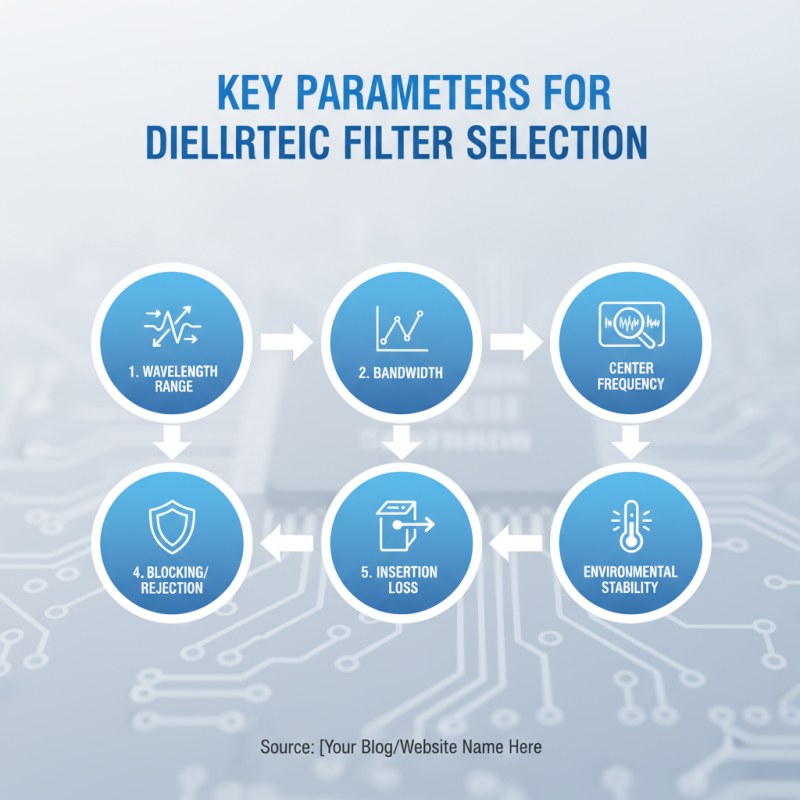
Selecting the right dielectric filters involves understanding several key parameters. First, consider the operating wavelength range. Different applications may require specific wavelengths, making this a critical choice. For example, communication systems often use specific bands. Knowing your application helps narrow down options.
Another essential factor is the filter's bandwidth. A narrower bandwidth allows for precise filtering of specific frequencies. However, too narrow may limit your application’s flexibility. Therefore, evaluate your requirements carefully. Additionally, the filter's rejection level is vital. This parameter indicates how much unwanted light is blocked. Higher rejection levels are often preferable for clearer signals.
Material and design also play significant roles. The type of material affects durability and performance. Glass and coated substrates have unique properties. Yet, not all materials perform equally under varying environmental conditions. Lastly, consider the filter’s size and form factor. Sometimes, space constraints lead to compromises. Balancing these parameters ensures you make an informed choice.
Comparison of Dielectric Filter Types: Thin Film vs. Coating Solutions
When selecting dielectric filters, understanding the types available is crucial. Thin film filters offer high precision with layered designs. They can achieve narrowband performance and are often preferred in scientific applications. Their construction allows for precise tuning of wavelengths. Research indicates that thin film technology can provide over 90% transmission efficiency in specific bands. This makes them ideal for demanding optical applications.
Coating solutions, on the other hand, promise versatility. They are applied directly onto surfaces and can be less expensive to manufacture. However, the performance may depend on the substrate materials used. A recent report noted that while coatings can reach 85% efficiency, they may struggle with consistency across broader spectra. This can lead to variations in performance that many users do not anticipate.
In practical terms, the decision often narrows down to application-specific needs. Choosing between thin film and coating could involve trade-offs. For instance, thin films excel in high-performance environments, but may not be cost-effective for all users. In contrast, coatings provide flexibility but can vary in reliability. Reflecting on these factors becomes essential for making an informed choice.
Comparison of Dielectric Filter Types: Thin Film vs. Coating Solutions
| Feature |
Thin Film Filters |
Coating Solutions |
| Transmission Efficiency |
High (80-95%) |
Moderate (70-85%) |
| Bandwidth |
Narrow (1-10 nm) |
Wider (10-50 nm) |
| Cost |
Higher |
Lower |
| Durability |
Medium |
High |
| Heat Resistance |
Good |
Excellent |
| Customization |
Limited |
Highly Customizable |
Industry Applications of Dielectric Filters: From Telecom to Medical Devices
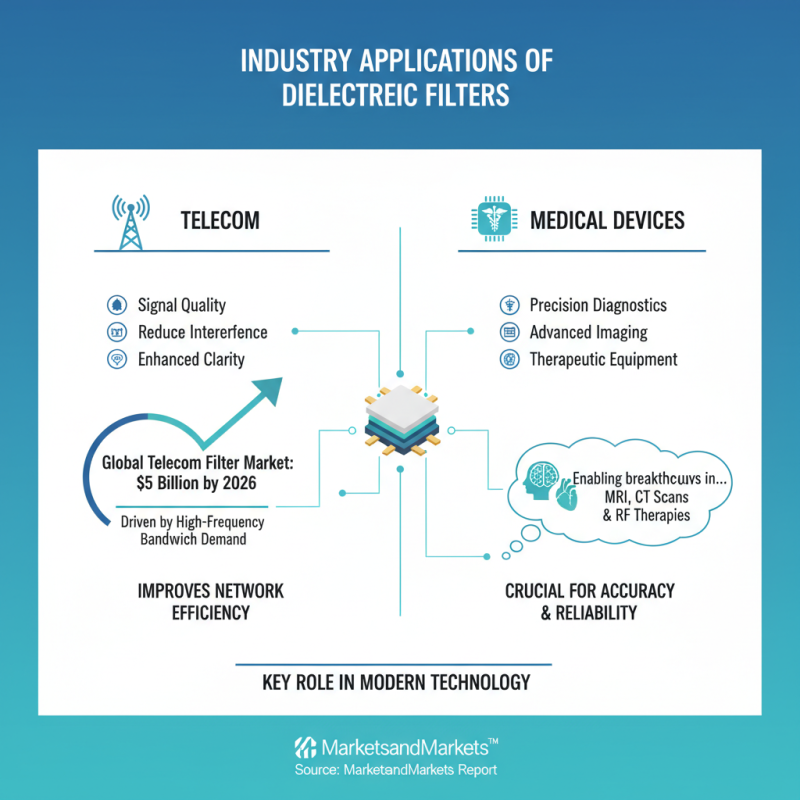
Dielectric filters play a crucial role in various industries, from telecommunications to medical devices. In telecom, these filters help manage signal quality. They reduce interference and enhance communication clarity. According to a report by MarketsandMarkets, the global telecom filter market is expected to reach $5 billion by 2026, driven by increased demand for high-frequency bandwidth. The right dielectric filters can improve network efficiency in this sector significantly.
In the medical field, dielectric filters ensure precision in diagnostic equipment. They are vital in imaging devices, ensuring accurate signal processing. A study from Grand View Research shows the medical devices market is projected to grow at a CAGR of 5.4% from 2021 to 2028. This growth emphasizes the importance of selecting appropriate filters. Using lower-quality filters may lead to misdiagnosis or equipment malfunction. The reliability of dielectric filters can substantially impact patient outcomes.
Choosing the right dielectric filter involves analyzing specific needs. Not all applications require the same specifications. Environmental factors also play a role in performance. Users must consider factors like temperature and humidity. There is a fine line between cost and quality. Overemphasis on budget can lead to compromised results. Balancing these factors is essential for optimum performance in all applications.
Evaluating Performance: Transmission, Reflection, and Bandwidth Criteria
When selecting dielectric filters, evaluating their performance is crucial. Key factors include transmission, reflection, and bandwidth. Transmission rates can significantly affect the effectiveness of optical devices. According to a recent industry report, high-quality dielectric filters can achieve transmission rates above 90% in desired wavelength ranges. This efficiency is vital for applications such as spectroscopy and telecommunications.
Reflection is another significant criterion. Filters with high reflectivity can cause issues, often leading to decreased overall system performance. The report noted that a reflection rate exceeding 5% could result in substantial signal loss in communication systems. Thus, it’s important to consider the characteristics of both transmission and reflection for optimal setup.
Bandwidth also plays a critical role. A narrower bandwidth filter may provide superior selectivity but can sacrifice signal strength. Studies indicate that filters with a bandwidth of less than 20 nm often yield stronger signals. However, they may also limit the range of applicable wavelengths. This compromise necessitates careful consideration based on specific application needs. In choosing the right dielectric filter, it is essential to weigh these attributes against your operational requirements.
Dielectric Filters Performance Evaluation