10 Essential Tips for Understanding and Using Low Pass Filters Effectively
In the rapidly evolving landscape of audio engineering and signal processing, the significance of Low Pass Filters (LPFs) cannot be overstated. LPFs are essential tools employed to allow signals with a frequency lower than a certain cutoff frequency to pass, while attenuating higher frequencies. According to a recent report by the Audio Engineering Society, the global market for audio filters is projected to reach $3.5 billion by 2025, reflecting the increasing demand for high-fidelity audio processing. This trend emphasizes the need for professionals to not only understand but also effectively utilize LPFs in their projects.
Expert audio engineer Dr. Emily Hargrave, a prominent figure in the field, states, “Mastering the application of Low Pass Filters can significantly enhance sound quality and clarity, whether in music production or telecommunications.” Her insights highlight the increasing reliance on LPFs for achieving desired audio outcomes, steering professionals towards a deeper comprehension of filtering techniques. As audio systems trend towards higher complexity, grasping the fundamentals of LPFs becomes crucial for engineers aiming to optimize their sound designs and meet the expectations of industry standards. This article will explore ten essential tips for understanding and using Low Pass Filters effectively, positioning you for success in this dynamic field.

What is a Low Pass Filter and Its Purpose in Signal Processing
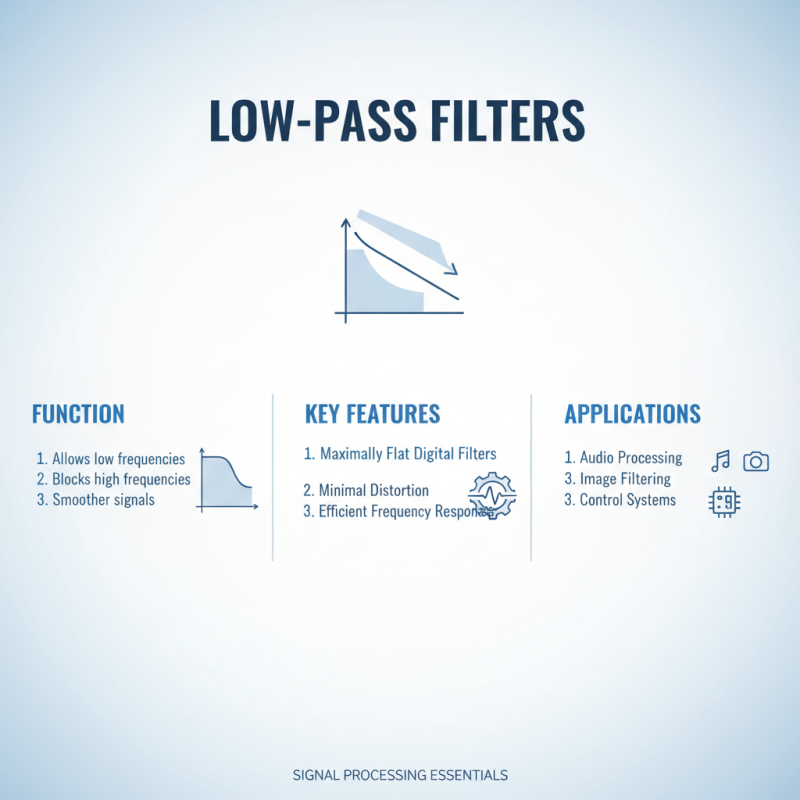
A low pass filter (LPF) is a crucial tool in signal processing, designed to allow signals with a frequency lower than a certain cutoff frequency to pass through while attenuating higher frequencies. This functionality is essential in various applications, including audio processing, image smoothing, and data acquisition, where it's vital to reduce unwanted high-frequency noise and preserve the integrity of the original signal. Understanding the purpose and operation of LPFs can significantly enhance your ability to manipulate and analyze signals effectively.
When using low pass filters, keep in mind that selecting the right cutoff frequency is essential. A tip for achieving optimal results is to consider the nature of your signal; for instance, in audio applications, ensuring the cutoff aligns with the desired audio spectrum can greatly improve clarity. Additionally, it’s important to experiment with different filter orders; a higher order filter will provide a steeper roll-off, which might be necessary for certain applications. Finally, always analyze the phase response of your filter, as it can affect the timing and synchronization of multi-channel audio or data signals.
Low Pass Filter Effectiveness Across Different Frequencies
Understanding the Frequency Response of Low Pass Filters
Low pass filters (LPFs) are critical tools in various applications requiring efficient frequency response handling. Understanding the frequency response of LPFs is essential, especially in the context of their maximally flat digital filter variants. Research indicates that these filters are widely utilized when useful signal energy is concentrated around specific frequencies, ensuring minimal distortion in signal processing. For instance, a recent study highlights the design of infinite impulse response filters with low group delay, which significantly enhances performance in applications, particularly those handling wide-band signals.
Additionally, the growing demand for ultra-low-power active filters emphasizes the importance of low-frequency applications, such as bio-signal sensing. A variable bandwidth memristor-based filter has shown promise, allowing for enhanced reusability and bandwidth control. Such advancements underline the necessity of optimizing filter design to cater to modern technological needs, which increasingly require compact yet efficient solutions. Understanding these intricate design elements informs users how to deploy LPFs most effectively across various engineering domains.
Different Types of Low Pass Filters and Their Applications
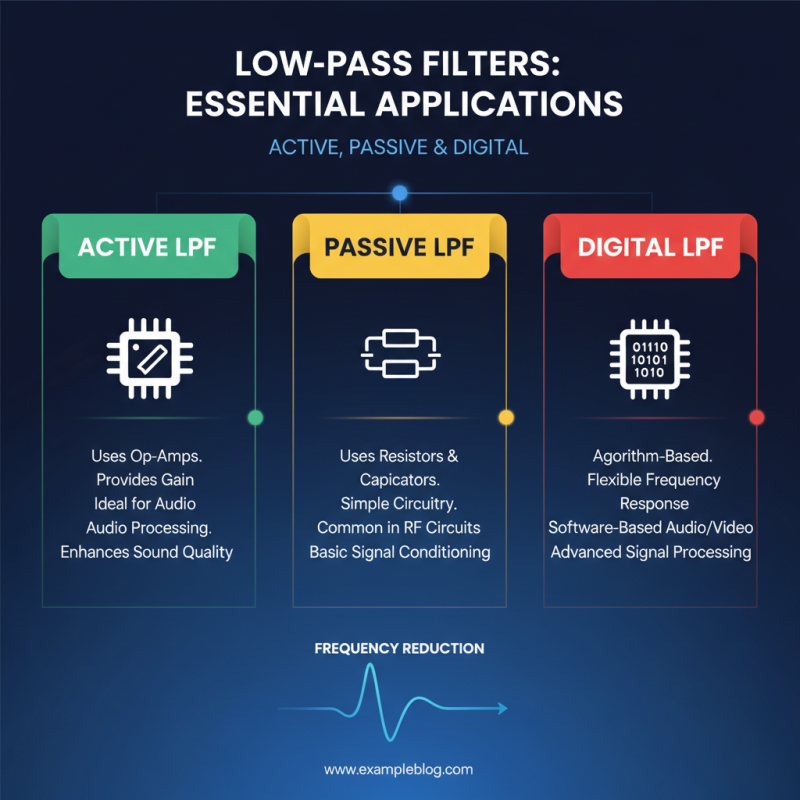
Low pass filters (LPFs) are essential in various applications, from audio processing to signal conditioning. Understanding the different types of LPFs, such as active, passive, and digital filters, can significantly enhance their usage. Active low pass filters utilize operational amplifiers and are favored for their ability to provide gain, making them ideal for audio applications where sound quality is paramount. Passive filters, on the other hand, are simpler, consisting of resistors and capacitors, and are often used in situations where circuit simplicity is essential, such as in radio frequency circuits. Digital low pass filters process signals using algorithms, offering flexibility in controlling frequency response, making them prevalent in software-based audio and video processing.
When utilizing low pass filters, one crucial tip is to consider the cut-off frequency carefully, as it determines the filter's performance. Selecting the appropriate cut-off point ensures that the desired signals are retained while unwanted noise is attenuated. Additionally, understanding the filter's order can help achieve a steeper roll-off, effectively reducing frequencies that interfere with the desired output. Lastly, always simulate the filter design when possible, as this can prevent costly mistakes and provide insights into the filter’s behavior in real-world applications. By leveraging these tips, you can harness the full potential of low pass filters in your projects.
Practical Tips for Designing and Implementing Low Pass Filters
When designing and implementing low pass filters, it's crucial to start with a clear understanding of the desired frequency response. One effective approach is to define the cutoff frequency, which determines the boundary between the passband and the stopband. By carefully selecting this frequency, designers can ensure that only the desired signals pass through while minimizing unwanted noise and interference. Use tools like Bode plots to visualize how different component values influence the filter’s performance, thus aiding in fine-tuning the design.
Another essential consideration is the choice of components—resistors, capacitors, and sometimes inductors—each affecting the filter's behavior differently. For instance, using high-quality capacitors can reduce distortion and lead to better performance. Additionally, consider the implementation method: passive filters offer simplicity and low cost, whereas active filters provide enhanced performance at the expense of complexity and power consumption. Testing different configurations and iterating based on performance metrics will lead to more effective low pass filters.
Common Mistakes to Avoid When Using Low Pass Filters in Projects
When working with low pass filters, understanding common mistakes is crucial for achieving the desired audio or signal results. One frequent error is selecting an inappropriate cutoff frequency. If the cutoff is set too high, it may allow unwanted high-frequency noise to pass through, undermining the filter's purpose. Conversely, setting it too low can result in a loss of essential high-frequency details, leading to a dull sound or a lack of clarity in the signal. It’s important to carefully consider the frequency range you want to preserve and set the cutoff accordingly.
Another common pitfall is neglecting the filter's resonance or Q factor. A poorly adjusted Q can create unwanted peaks in the response curve, which may introduce distortions or an overly pronounced sound that detracts from the mix. Additionally, some users mistakenly rely solely on visual representations of the filter response, ignoring how it actually interacts with the audio material. It’s vital to listen critically and make adjustments based on how the filter affects the overall sound, rather than solely depending on graphical displays. By being aware of these mistakes, users can harness the full potential of low pass filters in their projects.