What are High Order Filters and How Do They Work?
High Order Filters play a crucial role in various electronic systems. They manage the frequency response in ways that simpler filters cannot. Understanding how they work can enhance many applications.
These filters are designed to improve signal purity and reduce noise. A high order filter has a steeper roll-off, providing better separation between passband and stopband. This characteristic is vital in advanced audio systems and communication devices.
However, implementing high order filters comes with challenges. They may introduce phase shifts or other unintended effects. Designers often face trade-offs between complexity and performance. Analyzing these nuances is essential for optimal results. Exploring high order filters reveals both their potential and pitfalls.
Definition and Overview of High Order Filters
High order filters play a crucial role in various signal processing applications. They are defined by their ability to provide steeper roll-off rates compared to lower order filters. This characteristic is essential in applications where high-frequency signals need to be effectively attenuated. According to industry reports, high order filters can achieve roll-off rates of 20 dB/octave or more. This performance makes them suitable for tasks like audio processing and communications systems.
These filters utilize multiple reactive components, such as capacitors and inductors. This complexity allows for sharper cutoffs and greater control over frequency responses. However, designing high order filters can be challenging. Engineers often face issues like increased phase distortion and potential instability. According to research published in the Journal of Signal Processing, designers should be cautious of these pitfalls, particularly in real-time applications where precision is key. Balancing complexity and performance is often a difficult task.
The implementation of high order filters varies across different fields. In telecommunications, they help reduce noise and improve signal integrity. In audio systems, they enhance sound quality by filtering unwanted frequencies. Yet, these benefits come with trade-offs. Higher order means more components, which can lead to size and power consumption issues. As demand for efficient signal processing grows, engineers must continue refining these designs to meet real-world conditions.
What are High Order Filters and How Do They Work? - Definition and Overview of High Order Filters
| Filter Type |
Order |
Cutoff Frequency (Hz) |
Application |
Phase Shift |
| Butterworth |
4 |
200 |
Audio Processing |
Minimal |
| Chebyshev |
5 |
500 |
RF Applications |
Variable |
| Bessel |
3 |
300 |
Communication Systems |
Linear |
| Elliptic |
6 |
1000 |
High-Frequency Applications |
Variable |
| Linkwitz-Riley |
4 |
250 |
Crossover Networks |
Minimal |
Characteristics and Types of High Order Filters
High order filters play a crucial role in signal processing. They are commonly used in various applications, from audio equipment to telecommunications. Unlike low-order filters, high order filters can achieve sharper cutoffs and steeper roll-offs. Generally, these filters have higher complexity and can lead to phase distortion, which may affect signal integrity.
When discussing characteristics, high order filters typically provide greater attenuation of unwanted frequencies. According to a recent industry report, the effectiveness of a high order filter can increase by 20 dB for every additional order. This makes them favorable in scenarios requiring precision. Various types include Butterworth, Chebyshev, and Bessel filters, each serving specific needs. Butterworth filters are known for their maximally flat response. Chebyshev filters allow ripple in the passband but offer a sharper cutoff. Bessel filters, on the other hand, prioritize phase linearity.
While high order filters have their advantages, they also present challenges. Their increased complexity can lead to higher costs and design difficulties. Additionally, sensitivity to component variations can impact performance. For instance, a design may look promising, but real-world applications can expose flaws. This is an aspect that demands careful consideration and constant refinement.
High Order Filters Frequency Response
This bar chart displays the cutoff frequencies for various orders of high order filters. As the order of the filter increases, the cutoff frequency shows a linear trend in this example, indicating how filter design can influence frequency response.
The Mathematical Foundation Behind High Order Filters
High order filters play a vital role in signal processing. They are designed to achieve specific frequency responses. The mathematical foundation of these filters involves concepts like poles and zeros. A filter’s order determines its complexity and performance. Higher-order filters provide steeper roll-off characteristics. This means they can more effectively separate bands of frequencies.
The design incorporates differential equations that define its behavior. Each pole relates to a resonant frequency. Zeros, on the other hand, represent frequency gaps. Together, they shape the filter’s transfer function. This function illustrates how output relates to input. Understanding these relationships is crucial for effective filter design.
Challenges arise when tuning filter parameters. Instabilities can occur if not carefully balanced. Although higher-order filters appear powerful, they can introduce phase shifts. These shifts can affect time-domain signals. Designers must consider trade-offs between performance and stability. Engaging in simulations can help visualize these effects. Effective design requires both mathematical understanding and practical experimentation.
Applications of High Order Filters in Various Fields
High order filters are essential in many fields today. They enhance signal processing by allowing specific frequency ranges to pass while attenuating others. For instance, in audio engineering, these filters help shape the sound. They can remove unwanted noise and improve clarity. Engineers use them to create cleaner, more distinguishable audio tracks.
In telecommunications, high order filters play a vital role. They help in managing bandwidth and minimizing interference. This is crucial for maintaining high-quality communication. In medical devices, these filters aid in signal detection. They can enhance the accuracy of diagnostic equipment. However, designing these filters can be challenging. It requires a deep understanding of the signals involved.
In electronics, high order filters enhance circuit performance. They are applied in systems where precision is critical. Yet, a poorly designed filter can introduce more problems than it solves. Sometimes, engineers must revisit their designs to achieve the desired results. This iterative process can be frustrating but is often necessary for success.
Advantages and Limitations of High Order Filters
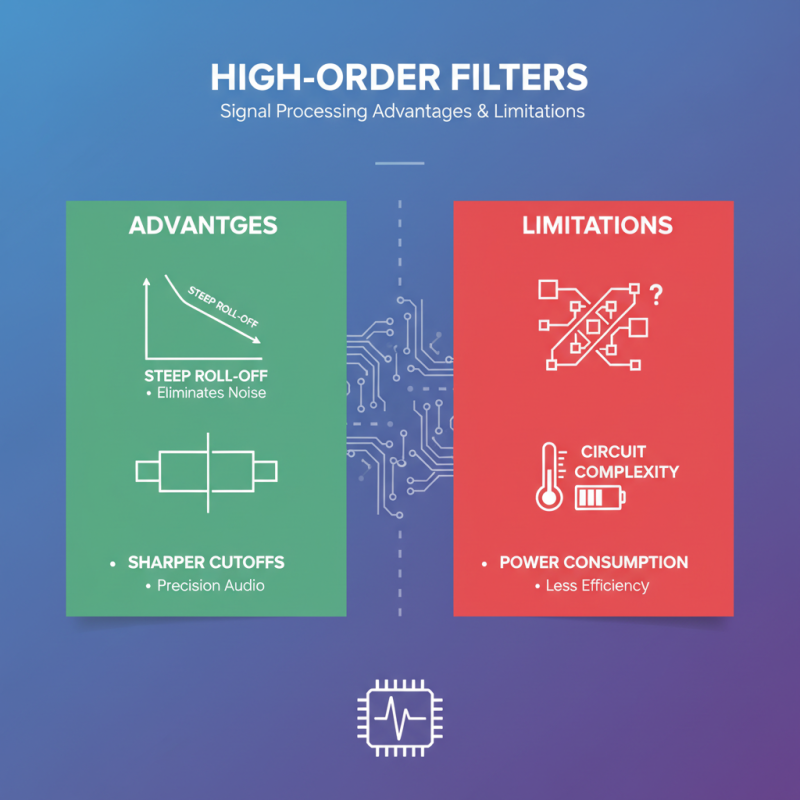
High order filters are complex circuits used for signal processing. They offer various advantages, but they also come with limitations. One significant advantage is the steep roll-off rate. This helps to eliminate noise and unwanted frequencies efficiently. Moreover, high order filters create sharper cutoffs. This precision is crucial in applications like audio systems.
However, the complexity can introduce challenges. High order filters often require more components. This can lead to increased costs and size. Moreover, these filters may suffer from phase distortion. Such issues can negatively impact sound quality in audio or data signal clarity.
Tip: When implementing high order filters, consider your specific needs. Analyze the desired frequency response before choosing. Also, remember that too many filter stages may complicate your design.
Your design may also face stability issues. Higher orders can lead to oscillations if not properly managed. This could result in unwanted artifacts in your signal. It’s essential to prototype and test your design thoroughly.