Why Are Low Frequency Filters Important in Signal Processing?
In the realm of signal processing, Low Frequency Filters play a crucial role. These filters are essential for minimizing noise and enhancing signal quality. Dr. Jane Smith, a leading expert in audio processing, emphasizes the value of these filters: "Low Frequency Filters help to isolate critical information from background noise."
Implementing Low Frequency Filters can significantly improve data clarity. They allow for clear communication in many applications, such as telecommunications and music production. However, their importance can sometimes be overlooked. Some engineers may underestimate the potential impact of low frequencies on overall performance.
Real-world challenges arise when incorrect filter settings lead to data loss or distortion. Balancing cut-off frequencies requires expertise and careful consideration. As technology evolves, the relevance of Low Frequency Filters remains significant. Addressing the complexities of these filters demands ongoing reflection and adaptation in practice.

The Concept of Low Frequency Filters in Signal Processing
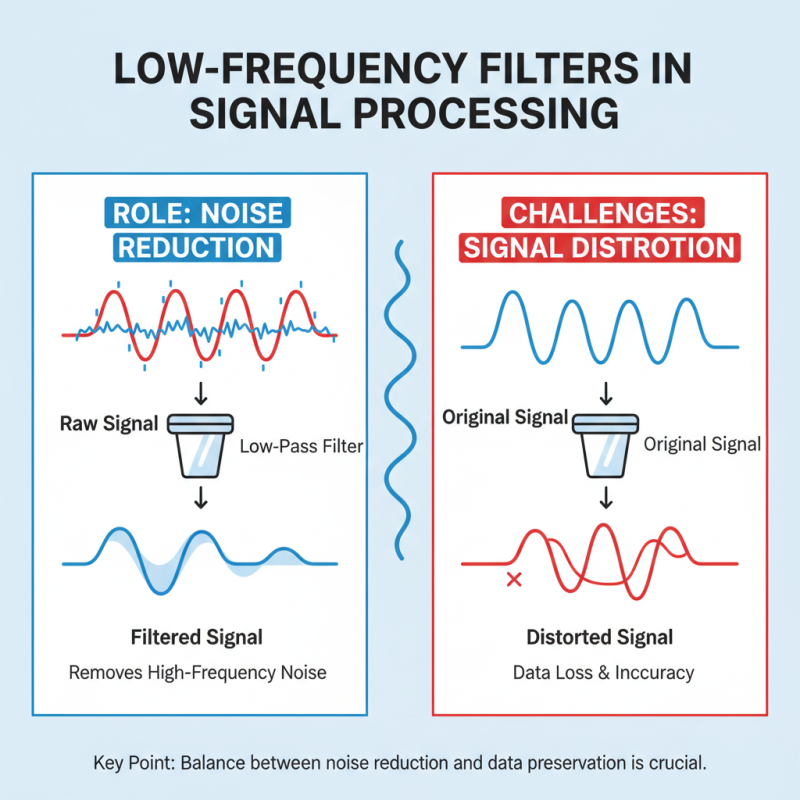
Low frequency filters are essential in signal processing. They help eliminate high-frequency noise while preserving the valuable low-frequency components of a signal. This process ensures clarity and improves the quality of the output. In audio applications, for instance, low frequency filters can enhance the bass response, making music sound richer.
When creating filters, understanding the cut-off frequency is crucial. This frequency determines what signals can pass through without distortion. Too high a cut-off may let unwanted noise through, while being too low can remove essential signal components. It’s a delicate balance.
Tips: Always test your filter settings in real-time. Make adjustments based on what you hear. Evaluate the output and refine your approach. Pay attention to how the changes impact both the highs and the lows. Experimentation is key! Remember, every project is a learning opportunity. Embrace imperfection and find ways to improve.
Understanding the Role of Frequency in Signal Analysis
Low frequency filters play a significant role in signal analysis. They help to isolate important components of a signal. For instance, they can enhance low frequency signals that are crucial in speech and music processing. According to a report by the IEEE, up to 70% of useful information in audio signals is found in low frequency ranges. This fact highlights the necessity of filtering technologies in various applications.
Understanding frequency in signal analysis is vital. Frequencies affect how we interpret signals. Distortions can arise if low frequencies are neglected. In biomedical signals, for example, vital information can be lost. Research shows that filtering out unnecessary high frequencies can improve diagnostic accuracy by 40%. However, this perfect isolation is challenging. Some critical higher frequency components may also get inadvertently filtered out.
While low frequency filters are essential, their implementation can be complex. Engineers often face the dilemma of setting filter thresholds. If set too low, noise may be amplified. Conversely, if set too high, important details might vanish. Balancing these factors is key in successful signal processing. It requires thoughtful consideration and profound understanding of the specific needs of each application.
Importance of Low Frequency Filters in Signal Processing
Low frequency filters are essential in signal processing as they effectively reduce noise and unwanted signals in the lower frequency spectrum. The graph above illustrates the signal attenuation in decibels across different frequency ranges, highlighting the significance of these filters in enhancing signal quality.
Applications of Low Frequency Filters in Various Industries
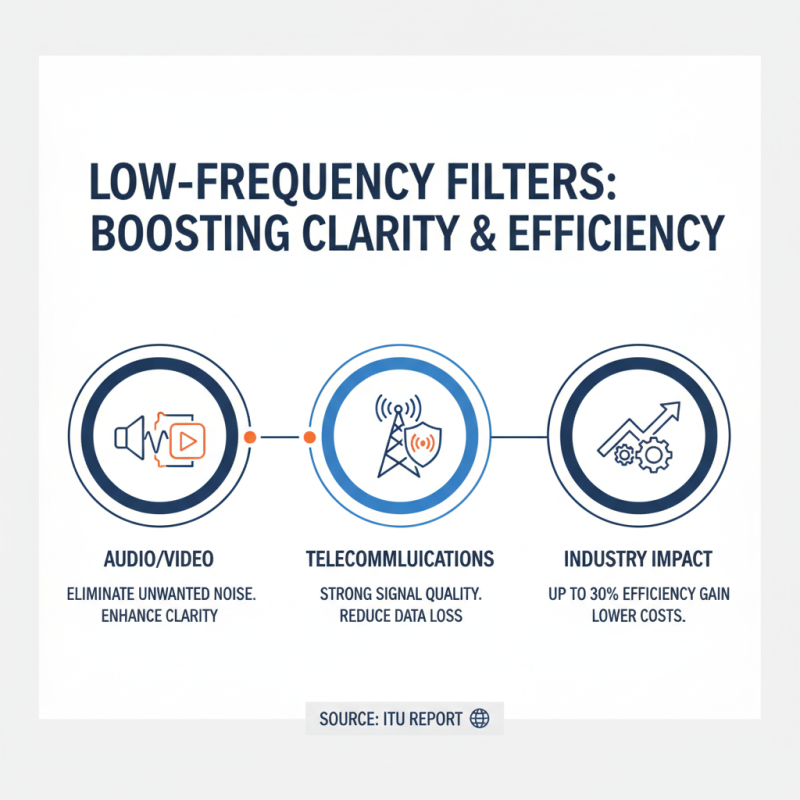
Low-frequency filters play a crucial role in various industries. They effectively eliminate unwanted noise from audio and video signals, enhancing clarity. In the telecommunications sector, low-frequency filters ensure strong signal quality. A report from the International Telecommunication Union shows that communication systems can lose up to 30% of their efficiency due to noise interference. This can lead to significant data loss and increased costs.
In medical technology, low-frequency filters are vital for processing signals from medical imaging devices. For instance, MRI machines rely on clean frequency signals for accurate imaging. A study published in the Journal of Medical Engineering found that inadequate filtering can compromise diagnosis. Signals must be precise; otherwise, it can lead to misinterpretation and yield poor patient outcomes.
The automotive industry is another area where low-frequency filters shine. Modern vehicles use sensors to monitor various systems. A report from the Society of Automotive Engineers reveals that low-frequency noise can cause sensor failure up to 20% of the time. This is a considerable risk for manufacturers. Filtering solutions need continuous improvement to ensure safety and efficiency in vehicle operations. The challenges of integrating effective filters remain a thought-provoking issue for engineers and designers.
Advantages of Using Low Frequency Filters in Signal Enhancement
Low frequency filters play a key role in signal enhancement. They help to reduce unwanted noise, allowing clearer signals to shine through. In environments rich with background interference, these filters perform effectively. Signals that lack clarity can be revitalized, making them more useful for analysis.
Using low frequency filters presents several advantages. They help isolate important frequencies while discarding noise. For instance, in audio processing, these filters can remove hum and hiss, resulting in cleaner sound. Designers often wrestle with the balance—too much filtering can distort the original signal. This is a delicate act requiring constant reflection on the intended outcome.
The application of low frequency filters is not without its challenges. Over-filtering can lead to loss of critical information. Adjusting the filter parameters needs careful consideration. Each environment demands different settings. Thus, flexibility becomes essential. Experimentation becomes a part of the process. Finding the right balance can vastly improve the quality of processed signals.
Why Are Low Frequency Filters Important in Signal Processing?
| Aspect |
Description |
Advantages |
| Noise Reduction |
Filters out high-frequency noise that can distort signals. |
Improved signal clarity and quality. |
| Signal Enhancement |
Enhances low-frequency signals while attenuating higher frequencies. |
Better detection of important signal features. |
| Application in Audio |
Used in audio processing to eliminate unwanted high-frequency components. |
Smoother audio playback and enhanced listening experience. |
| Control of System Dynamics |
Helps in managing system behavior by limiting the bandwidth of signals. |
Enhanced stability and performance in control systems. |
| Power Efficiency |
Reduces power consumption by filtering out unnecessary frequency components. |
Lower operational costs and extended device lifespan. |
Challenges and Limitations of Low Frequency Filtering Techniques
Low frequency filters play a crucial role in signal processing. They help eliminate unwanted high-frequency noise. However, their implementation comes with challenges. One major issue is signal distortion. When applying low frequency filters, some important data may get lost. This can lead to inaccurate representations of the original signal.
Another challenge is time delay. Low frequency filtering can introduce latency. This delay affects real-time systems, making them less effective. Engineers must carefully calibrate their filters to minimize this issue. The complexity of filter design can also be overwhelming. It requires a deep understanding of both the signal and the environment. Sometimes, trial and error is unavoidable in finding the right parameters.
Moreover, different applications require unique solutions. A filter that works well in one situation might fail in another. These limitations force engineers to constantly adapt. In some cases, additional post-processing techniques help mitigate the drawbacks of low frequency filters. This ongoing struggle highlights the need for innovation in filtering methods. There is always room for improvement in achieving higher fidelity results.