What is a Low Pass Filter and How Does It Work?
Understanding the concept of a Low Pass Filter is essential in various fields, including audio engineering and telecommunications. Renowned expert Dr. Emily Carter, a leading figure in signal processing, emphasizes, "Low Pass Filters allow only the essential frequencies to pass through." This highlights their critical role in enhancing sound quality and reducing noise.
A Low Pass Filter works by blocking higher frequencies while allowing lower frequencies to pass. This function is vital for preserving the integrity of audio signals. For instance, in music production, it helps in creating a smoother, more balanced sound. Without these filters, unwanted high-frequency noise can distort the primary audio signals. However, relying solely on Low Pass Filters may not be sufficient. Users often need to combine them with other filtering techniques to achieve optimal results.
While the effectiveness of Low Pass Filters is evident, choosing the right type can be challenging. Different applications require different specifications. It is important to explore and test various filters to find the best fit. The learning curve may be steep, but understanding the nuances of Low Pass Filters can lead to significant improvements in sound quality and clarity.
Definition and Purpose of Low Pass Filters
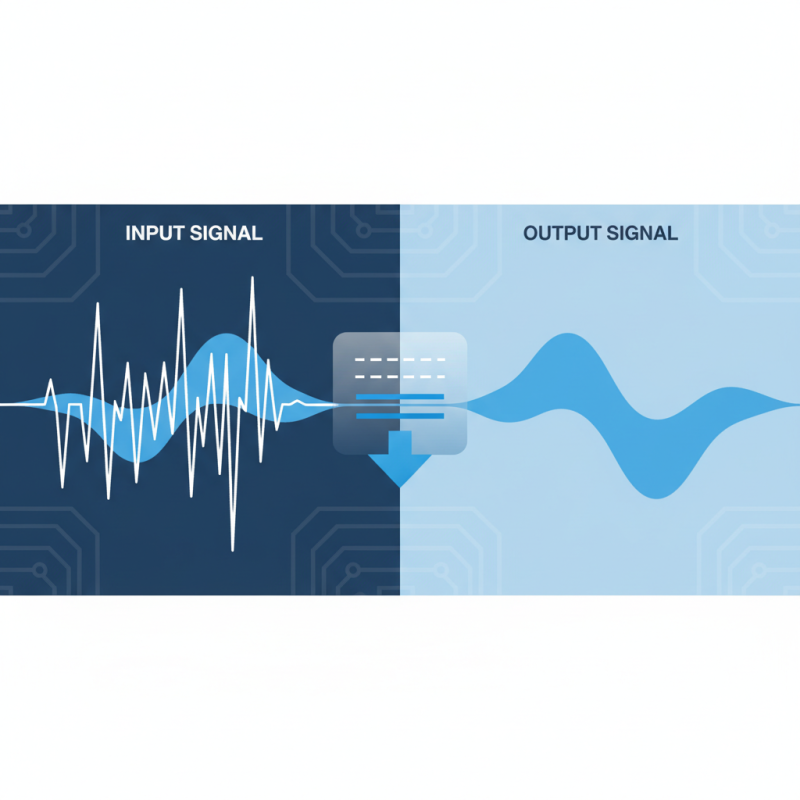
Low pass filters (LPFs) play a vital role in signal processing by allowing low-frequency signals to pass while attenuating higher frequencies. This filtering method is crucial in various applications, including audio processing, telecommunications, and biomedical signal processing. According to a report by MarketsandMarkets, the low pass filter market, particularly in digital signal processing, is projected to expand significantly, reaching $5 billion by 2025.
The primary purpose of an LPF is to reduce unwanted noise that exists at higher frequencies. For instance, in audio applications, LPFs can eliminate hiss or other high-frequency artifacts that detract from sound quality. Studies indicate that effective noise reduction can improve sound clarity by up to 30%. This aspect highlights the importance of using LPFs in environments with significant background noise or interference.
However, implementing low pass filters is not without challenges. Designers must balance the filtering process to avoid introducing undesirable phase shifts or degrading the signal integrity. Some reports suggest a potential 15% signal distortion when filters are not correctly tuned. This emphasizes the need for precise designs and an understanding of the specific context in which the filter will operate.
Working Principle of Low Pass Filters
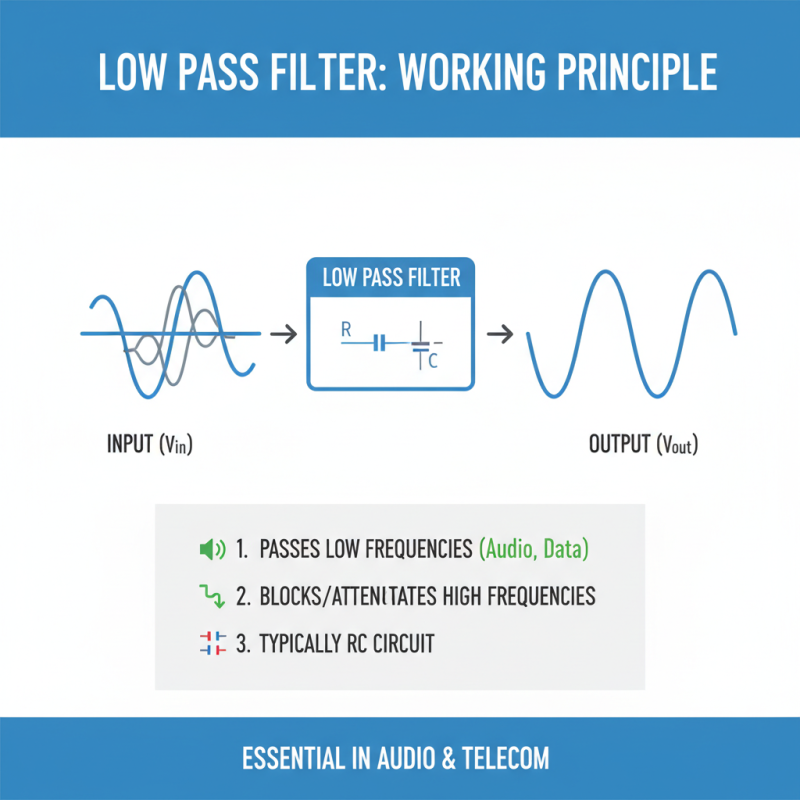
Low pass filters (LPFs) are essential components in various electronic devices. They allow low-frequency signals to pass while attenuating higher frequencies. This selective filtering is crucial in audio processing and telecommunications. The basic principle behind LPFs involves a combination of resistors and capacitors.
When an electrical signal enters an LPF, it encounters resistance and capacitance. The resistor limits the flow of current, while the capacitor allows alternating current (AC) to pass while blocking direct current (DC). As the frequency of the input signal increases, the impedance of the capacitor also increases. This results in reduced output for higher frequencies. Conversely, low frequencies see minimal attenuation, allowing them to pass through effectively.
Understanding the operational nuances of LPFs offers insights for various applications. For instance, engineers must consider the cutoff frequency, which determines the threshold between passing and attenuating signals. Incorrect calculations can lead to suboptimal filter performance. Testing different configurations can yield interesting results, revealing how capacitance and resistance interact in real-time situations. Such experimentation is vital, as each setting may yield varying outcomes that require careful analysis and adjustment.
Types of Low Pass Filters and Their Applications
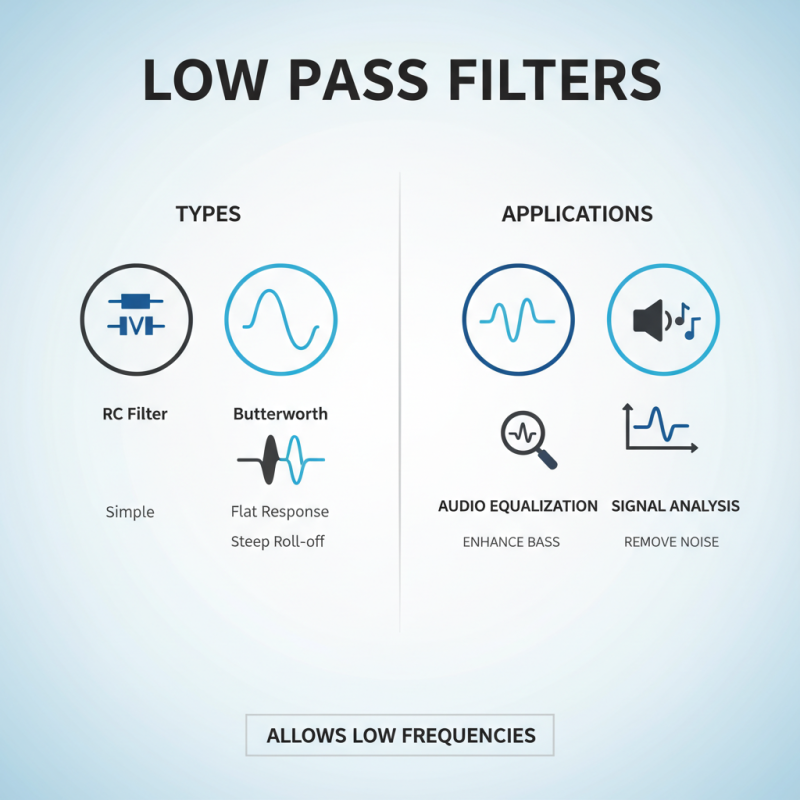
Low pass filters (LPFs) are essential components in various fields, primarily in audio processing and signal analysis. They allow low-frequency signals to pass through while attenuating higher frequencies. This functionality makes them crucial in applications like audio equalization. In these scenarios, they enhance bass sounds, making music richer and more engaging.
There are several types of low pass filters, including passive and active designs. Passive filters use resistors, capacitors, and inductors, and are simpler to design. Active filters, however, incorporate amplifying components, offering more flexibility in tuning. For instance, in telecommunications, LPFs help eliminate high-frequency noise from signals. This ability ensures clearer communication and improved performance in various systems.
Despite their advantages, LPFs can introduce a phase shift in signals, which may lead to distortion in some applications. Understanding this trade-off is crucial for engineers designing systems that require precise signal fidelity. Balancing performance with signal integrity can be challenging and may require multiple iterations in the design process.
Key Parameters and Design Considerations
Low pass filters (LPFs) are essential tools in signal processing. They allow low-frequency signals to pass while attenuating higher frequencies. The design of an LPF hinges on key parameters like cutoff frequency, order, and filter type. Each parameter affects filtering efficiency and response time.
Cutoff frequency determines the threshold for frequency attenuation. Careful selection is vital for desired outcomes. A lower cutoff can remove unwanted noise but may also impact signal fidelity. The filter order impacts the slope of attenuation. A higher order yields a sharper cutoff but introduces more complexity.
Tips: When designing an LPF, keep in mind the application and desired signal quality. Ensure your components can handle the expected frequencies. Experiment with different configurations to optimize performance. Lastly, monitor the changes in signal behavior closely. Adjusting parameters may lead to better results and avoid unforeseen issues.
What is a Low Pass Filter and How Does It Work? - Key Parameters and Design Considerations
| Parameter |
Description |
Typical Values |
| Cutoff Frequency (Fc) |
The frequency at which the output power drops to half of the input power (3 dB point). |
20 Hz to 20 kHz |
| Order |
Determines the steepness of the filter's roll-off; higher order means a sharper transition. |
1 to 8 |
| Filter Type |
The architecture of the filter, which affects performance and design complexity. |
Butterworth, Chebyshev, Bessel |
| Ripple |
Variation in the passband gain; affects the amplitude response. |
0.5 dB to 3 dB |
| Phase Shift |
The delay introduced to the signal at different frequencies. |
0° to 180° |
| Impedance |
Resistance to the signal, affecting how the filter interacts with other components. |
50 ohms, 75 ohms |
Benefits and Limitations of Low Pass Filters
Low pass filters (LPFs) are invaluable in various applications, from audio processing to signal conditioning. They allow low-frequency signals to pass through while attenuating higher frequencies. This characteristic is essential in reducing noise and improving signal clarity. However, while LPFs offer clarity in certain contexts, they come with benefits and limitations.
One major benefit of LPFs is their ability to smooth out signals. For instance, in audio applications, they can eliminate harsh high-frequency sounds. This leads to a richer, warmer audio experience. Additionally, LPFs can help prevent aliasing in digital signal processing. However, their limitations become apparent when dealing with signals that require higher frequency components. In some cases, essential details might be lost. This can occur if the cutoff frequency is set too low.
Moreover, the effectiveness of a low pass filter can vary based on design and implementation. A poorly designed LPF might not adequately attenuate undesired frequencies, leading to subpar performance. Understanding these factors is critical for engineers and technicians. With careful consideration, one can harness the power of LPFs while recognizing their potential weaknesses.