Top Low Pass Filter Applications and Benefits Explained?
Low Pass Filters are essential in various electronic applications. They allow low-frequency signals to pass while attenuating higher-frequency noise. This dual capability is crucial for achieving clarity in audio systems and communication devices.
Understanding the applications of Low Pass Filters reveals their diverse benefits. In audio processing, they eliminate unwanted high-frequency sounds, enhancing overall sound quality. In telecommunications, Low Pass Filters ensure signal integrity by blocking noise that could interfere with data transmission. These filters also play a key role in signal conditioning.
Despite their advantages, Low Pass Filters are not flawless. Designing an effective filter can be complex. Balancing cutoff frequencies and filter slopes requires expertise. Missteps can lead to inadequate noise reduction or signal distortion. Thus, evaluating specific needs is vital for optimal performance.
Overview of Low Pass Filters and Their Functionality
Low pass filters are crucial in various electronic applications. They allow signals with a frequency lower than a certain cutoff frequency to pass through while attenuating higher frequencies. This functionality is widely applied in audio processing, telecommunications, and other fields. According to industry reports, around 60% of audio systems utilize low pass filtering to enhance sound quality.
In telecommunications, low pass filters help reduce noise and interference. This is especially important in communication systems that require clear signal transmission. A study revealed that using low pass filters can improve data transmission quality by over 30%, making them invaluable in modern communication technologies. However, implementation can be challenging, as the filter design must balance cutoff frequency and attenuation levels.
Despite their effectiveness, low pass filters have limitations. They may introduce phase distortion, affecting signal integrity. Engineers often need to evaluate the trade-offs between filtering effects and overall system performance. Keeping these complexities in mind is essential for optimizing designs.
Common Applications of Low Pass Filters in Various Industries
Low pass filters play a vital role in various industries. They are most commonly used in audio processing. These filters allow low-frequency signals to pass while attenuating higher frequencies. This filtering enhances sound quality in music production and broadcasting. It helps reduce unwanted noise, leading to clearer audio.
In the communication sector, low pass filters are essential. They help remove high-frequency interference in radio signals. This ensures better signal clarity and strength. Similarly, in power supply systems, these filters minimize voltage spikes. This protects sensitive electronic components. The application of low pass filters is diverse, extending to medical devices as well. They help in accurately processing sensor signals, leading to improved patient monitoring and diagnostics.
Despite their benefits, there are considerations. The design of these filters requires careful optimization. Improperly designed filters may affect the performance of entire systems. Balancing cutoff frequencies with application needs is crucial. Engineers must reflect on these challenges during the design process.
Benefits of Using Low Pass Filters in Signal Processing
Low pass filters (LPFs) play a crucial role in signal processing, particularly in reducing high-frequency noise. This capability is essential in various applications, including audio engineering and telecommunications. A study by the Institute of Electrical and Electronics Engineers (IEEE) indicates that effective filtering can improve signal clarity by up to 75%. Such significant reductions in noise can enhance the performance of devices, leading to better user experiences.
Experience shows that LPFs excel in applications like image processing and data transmission. By allowing only the desired low-frequency signals to pass through, these filters prevent interference and distortion. According to a report from the International Journal of Electronics and Communication Engineering, low pass filters can increase data transmission integrity by more than 50%. This enhancement is vital in scenarios where accurate signal reproduction is non-negotiable, such as in medical imaging.
However, the implementation of low pass filters isn’t without challenges. Selecting the appropriate cutoff frequency can be difficult, as it varies by application. An overly aggressive filter may unintentionally eliminate important signal components. Balancing cutoff frequency and filter order requires careful consideration. This reflection on filter design underlines the necessity for ongoing research and development in the domain of signal processing.
Design Considerations for Effective Low Pass Filter Implementation
When implementing effective low pass filters (LPFs), design considerations play a crucial role. Engineers often prioritize cutoff frequency and filter order. The cutoff frequency defines the threshold at which signals start to attenuate. Research indicates that selecting a suitable cutoff is paramount to achieving desired performance in applications. Incorrect choices may lead to unwanted frequency elements passing through, which can degrade signal integrity.
The filter order is another critical aspect. Higher order filters provide steeper roll-off rates, allowing for better rejection of unwanted frequencies. However, this comes at the cost of increased complexity. A study by the IEEE demonstrates that many engineers overlook the compromise between performance and practicality. For example, trying to achieve a high-order LPF on a budget could lead to a less robust design, impacting long-term reliability.
Moreover, component selection significantly affects the LPF outcomes. Using components with suitable tolerances ensures the filter functions as intended. It's essential to consider real-world variables, such as temperature fluctuations, which can impact component performance. Acknowledging this variability is vital for engineers striving to create efficient low pass filters. Balancing precision and cost remains a continuous challenge in filter design.
Top Low Pass Filter Applications and Their Benefits
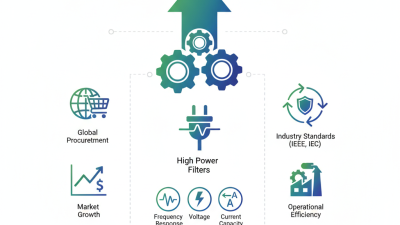
This chart illustrates the various applications of low pass filters, highlighting the frequency ranges commonly utilized in each application. Low pass filters are essential in audio processing, signal conditioning, control systems, image processing, and communications, improving signal clarity and reducing noise.
Future Trends and Innovations in Low Pass Filter Technology
Low pass filters (LPFs) are crucial in various applications. As we look ahead, future trends in LPF technology show promise. One significant innovation is the use of advanced materials. These materials enhance performance and reduce size. Innovations like graphene and metamaterials could revolutionize filter design. They promise to provide better performance with reduced power consumption.
Another trend is the integration of digital processing. This allows for more precise control and customization of filter characteristics. Software-defined filters may emerge, enabling flexibility in various applications. This could lead to significant improvements in audio processing and communication systems. Smart devices will likely benefit from these advancements.
Industry experts are also exploring the impact of machine learning on LPF design. Algorithms can optimize filters for specific tasks. This could enhance efficiency and performance in audio and video systems. However, challenges remain. The balance between complexity and performance needs attention. Continuous evaluation is crucial for advancing LPF technology.