Top Waveguide Filters in 2026 What You Need to Know?
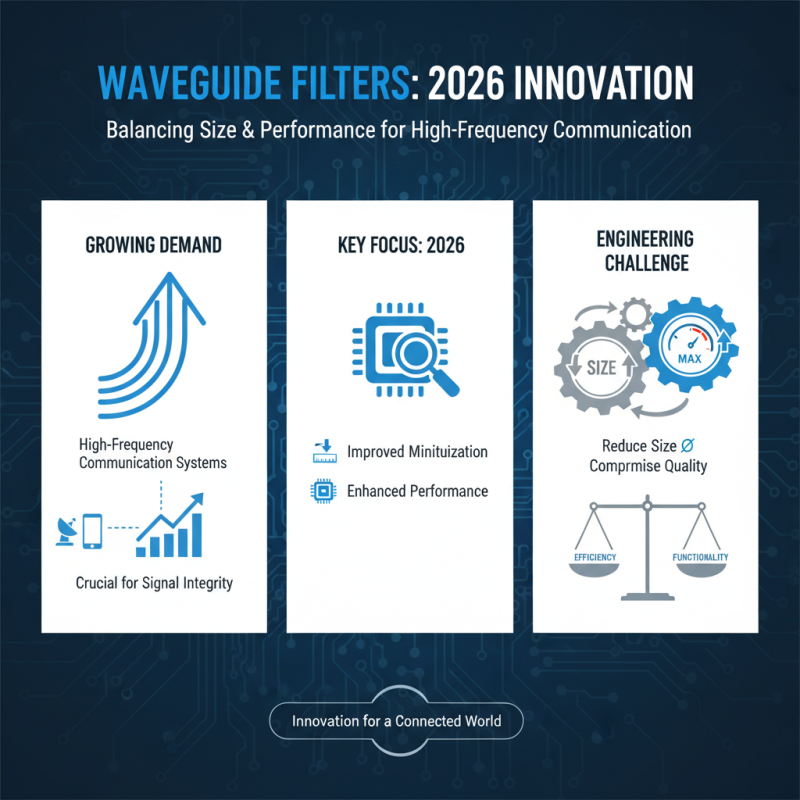
As the demand for high-frequency communication grows, Waveguide Filters are at the forefront of technological advancements. According to a recent report by MarketsandMarkets, the global waveguide filter market is projected to reach $1.2 billion by 2026, driven by their efficiency in managing signal integrity. These filters are essential in various applications, such as satellite communications and radar systems, where precision is key.
The landscape of waveguide filters is evolving rapidly. Emerging materials and manufacturing techniques are enhancing their performance, yet challenges remain. Manufacturers must address issues like cost and scalability. Smaller, more compact designs could lead to performance trade-offs that need careful consideration. Furthermore, the transition to next-generation wireless technologies introduces complexity to filter design and application.
As we look ahead to 2026, understanding Waveguide Filters becomes crucial. Engineers and technologists must stay informed about trends and innovations. Knowledge about material properties and design methodologies will be vital. This evolving field demands constant reflection on the balance between performance, cost, and practicality in design choices.

Overview of Waveguide Filters and Their Importance in 2026
Waveguide filters are essential in modern communication systems. They control signal flow and help improve performance. In 2026, the demand for high-frequency filtering will rise. This is due to the increase in wireless devices and the need for efficient signal processing. These filters are unique. They are designed to operate within specific frequency ranges, ensuring minimal loss and high selectivity.
As technology advances, waveguide filters will evolve. They will likely incorporate new materials and designs. This may lead to better efficiency and smaller sizes. However, challenges remain. Designing filters that manage heat and maintain high performance is crucial. Engineers cannot overlook these areas.
Moreover, the manufacturing process must get more precise. Quality control is essential. Small imperfections can greatly affect filter performance. This continuous need for fine-tuning presents both challenges and opportunities for innovation. The future of waveguide filters is promising, yet it calls for ongoing reflection and improvement. The industry needs to embrace change for better solutions.
Top Waveguide Filters in 2026 What You Need to Know?
| Filter Type |
Frequency Range (GHz) |
Insertion Loss (dB) |
Passband Width (GHz) |
Application Area |
| Bandpass Filter |
1.0 - 2.0 |
1.5 |
0.5 |
Telecommunications |
| Lowpass Filter |
0.1 - 1.0 |
2.0 |
N/A |
Satellite Communications |
| Highpass Filter |
2.0 - 10.0 |
3.0 |
1.0 |
Microwave Applications |
| Bandstop Filter |
3.0 - 6.0 |
2.5 |
2.0 |
Radio Frequency |
Key Technologies Driving Waveguide Filter Innovations
Waveguide filters are becoming crucial in various communication technologies. Innovations in this area are largely driven by advancements in materials and manufacturing processes. According to a recent report, the waveguide filter market is projected to grow by over 15% annually until 2026. This growth is fueled by the increasing demand for high-frequency applications.
Key technologies influencing these innovations include advanced ceramics and integrated photonic components. These materials improve performance and reduce size. For instance, advanced ceramics can withstand higher temperatures and provide better stability. Moreover, advancements in 3D printing are enabling more complex designs. However, some manufacturers struggle with the consistency of these processes, resulting in variable quality.
Another critical factor is the integration of artificial intelligence in design algorithms. AI can optimize filter performance and reduce development time significantly. However, there are concerns about reliance on AI, as it can lead to unforeseen design flaws. Continuous validation is necessary to ensure reliability. Understanding these technologies is vital for stakeholders aiming to stay competitive in the evolving market of waveguide filters.
Top Waveguide Filter Manufacturers and Their Market Shares
Waveguide filters have gained traction in the communication sector. The landscape in 2026 is diverse, showcasing various manufacturers and their market shares. Some firms dominate the market, while others hold niche segments. This diversity fosters innovation and competition.
When examining top manufacturers, it’s essential to consider their technology advancements. Many focus on improving efficiency and reducing size. However, some may lag behind in adapting to market trends. Analyzing their product offerings reveals strengths and weaknesses.
Tips: Always review the manufacturer’s recent innovations. Check their partnerships to gauge stability. Explore customer feedback for insights on performance. These steps can influence buying decisions significantly. Adapting quickly to new trends is vital. Keeping up with market shifts can be a challenge. Reflection on choices made will likely lead to better future decisions.
Applications and Use Cases for Waveguide Filters in Modern Systems
Waveguide filters are essential components in modern communication systems. They play a crucial role in mitigating unwanted signals. Applications span various fields, including telecommunications, radar, and satellite systems. For example, in telecommunications, waveguide filters ensure signal clarity. They selectively allow desired frequencies to pass while blocking noise.
In radar systems, these filters improve target detection. By reducing interference, they enhance operational accuracy. Spacecraft communication heavily relies on waveguide filters. They maintain signal integrity over vast distances. A smaller size can be a limitation, impacting ease of integration. Designers must balance size with functionality, often a tricky task.
Waveguide filters also have emerging applications in sensing technology. They are being explored for environmental monitoring and medical diagnostics. This reflects a growing trend toward multifunctional devices. While potential is high, challenges remain. The complexity of design and high manufacturing costs can hinder widespread adoption. As we advance, continuous innovation is necessary to address these issues.
Future Trends and Predictions for Waveguide Filter Development
As the demand for high-frequency communication systems continues to grow, waveguide filters play a crucial role in signal integrity. In 2026, innovations in these filters are expected to focus on improved miniaturization and performance. Engineers are looking for ways to reduce size without compromising quality. This presents a challenge as they balance efficiency and functionality.
Emerging materials, such as advanced ceramics, could offer enhanced properties. These materials promise better temperature stability and lower losses at high frequencies. However, there's a need for further research to understand their long-term reliability. Engineers must also consider manufacturing techniques. Traditional methods may not be suitable for new designs. Finding a balance between cost and performance remains an ongoing struggle.
Moreover, the move towards digital transformation in communication systems may influence waveguide filter design. Software simulations are becoming more sophisticated, allowing for rapid prototyping. Yet, this may create a disconnect between theoretical models and real-world application. Engineers must reflect on these discrepancies as they innovate. The road ahead is filled with potential and uncertainty, making the evolution of waveguide filters an exciting space to watch.