Top Waveguide Filters for Efficient Signal Transmission?
In the realm of modern telecommunications, Waveguide Filters play a crucial role. These essential components ensure efficient signal transmission, minimizing losses and maximizing performance. Dr. Alice Thompson, a renowned expert in microwave engineering, emphasizes the importance of these filters, stating, "Waveguide Filters are pivotal for high-frequency applications, offering unmatched reliability in signal integrity."
The emerging demand for high-speed communication systems and satellite technology has heightened the need for advanced Waveguide Filters. These filters can selectively allow or block certain frequencies, refining the signal quality. A well-designed filter can mean the difference between clear communication and disruptive noise. However, not all Waveguide Filters are created equal; some may introduce unwanted complexities.
Manufacturers must balance performance and design intricacies. Continuous innovation is necessary to improve efficiency while addressing challenges in production and integration. The future of Waveguide Filters lies in their adaptability and precision, responding to ever-changing technological demands.

Overview of Waveguide Filters and Their Importance in Signal Transmission
Waveguide filters play a crucial role in efficient signal transmission across various communication systems. They control the frequency response of signals traveling through waveguides, ensuring that only desired frequencies pass while unwanted ones are attenuated. This selectivity is vital in reducing noise and interference, leading to clearer signals.
The design of waveguide filters can be complex. Engineers must carefully consider physical dimensions, material properties, and operational frequencies. Small errors in design can significantly impact performance, leading to suboptimal filtering results. It is essential to test these filters rigorously in real-world applications. Often, the results reveal discrepancies that demand further refinement and iterative design changes.
However, even with advanced techniques, limitations exist. Factors like manufacturing tolerances and environmental conditions can affect filter performance. This reality challenges designers to balance ideal specifications with practical constraints. Continuous innovation and testing are vital to overcoming these issues and improving signal integrity in high-frequency applications.
Types of Waveguide Filters Used in Modern Communication Systems
Waveguide filters play a crucial role in modern communication systems. They manage signal transmission and maintain high efficiency. These filters come in various types, each serving a unique purpose.
Common types include:
bandpass filters, low-pass filters, and high-pass filters.
Bandpass filters allow signals within a specific frequency range to pass through, blocking others. This feature is vital for avoiding interference in communication lines.
Low-pass filters are another essential type. They enable lower frequency signals while attenuating higher frequencies. This is especially useful in applications where preserving low-band signals is critical.
High-pass filters, conversely, do the opposite by allowing higher frequency signals to pass through.
The selection of filter type depends on the specific needs of the communication system.
Implementing the right waveguide filter can be challenging. Designers often face trade-offs between filter performance and size. Some filters may not achieve the desired bandwidth while remaining compact.
This balance is crucial for optimizing signal clarity and system efficiency. Thus, understanding these different waveguide filter types is vital for anyone involved in the communications field.
Key Parameters for Evaluating Waveguide Filter Performance
When evaluating waveguide filter performance, several key parameters come into play. Insertion loss is critical. It determines how much signal is lost as it passes through the filter. A low insertion loss means efficient signal transmission. Next is the return loss, which reflects how much of the signal is reflected back due to impedance mismatches. A high return loss is generally desirable, indicating better performance.
Another important factor is the cutoff frequency. This frequency defines the operational range of the filter. It must match the required specifications for optimal performance. Bandwidth is also essential—it describes how well the filter can handle signal variations without distortion. A narrower bandwidth can lead to better selectivity but may also limit the signal range.
Lastly, group delay affects how different frequencies within the signal are processed. If the group delay varies significantly across the passband, it can lead to phase distortion. This can be a concern for sensitive applications. Evaluating these parameters holistically is vital. It ensures that the waveguide filter meets the required technical specifications. Balancing these factors can present challenges, but understanding them leads to better designs and implementation.
Applications of Waveguide Filters in Various Industries
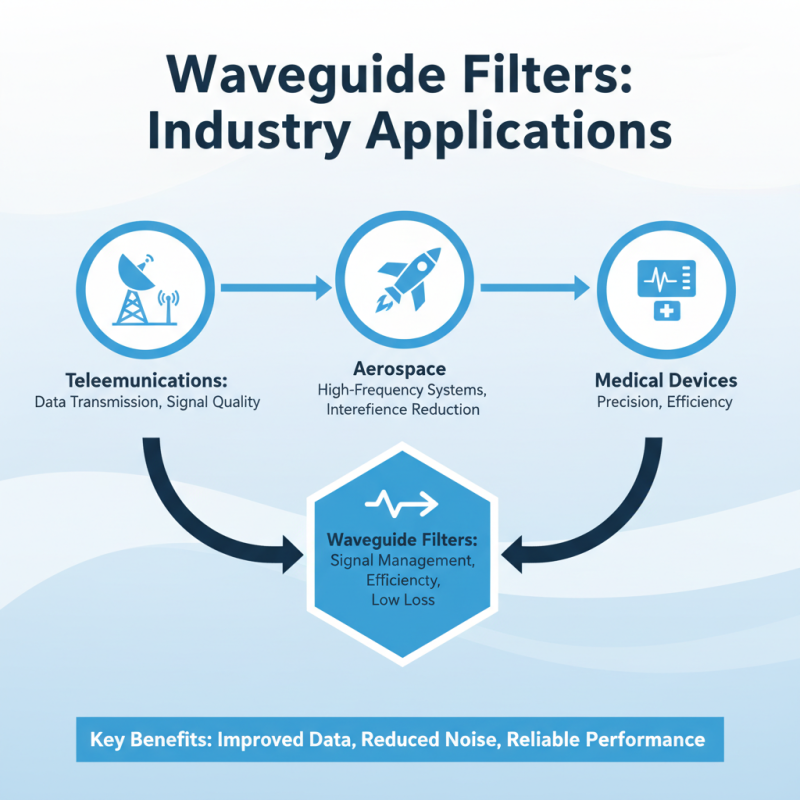
Waveguide filters are crucial in various industries. They play a significant role in sectors like telecommunications, aerospace, and medical devices. Their design helps manage signal quality and ensures efficiency. In telecommunications, these filters improve data transmission, minimizing loss. High-frequency signals benefit from waveguide structures, which reduce interference.
In the aerospace industry, waveguide filters are vital for radar and communication systems. They withstand extreme conditions, maintaining signal integrity. This reliability is key for aircraft and satellite operations. Medical devices also leverage waveguide technology for precise imaging and data communication. The ability to handle high-frequency signals is essential in such applications.
While waveguide filters offer numerous advantages, challenges exist. Designing filters for specific environments can be complex. There is often a trade-off between size and performance. Engineers must consider various factors to optimize their designs. Continuous innovation is necessary to meet the demanding needs of these industries. Balancing efficiency and effectiveness remains an important focus.
Future Trends and Innovations in Waveguide Filter Technology
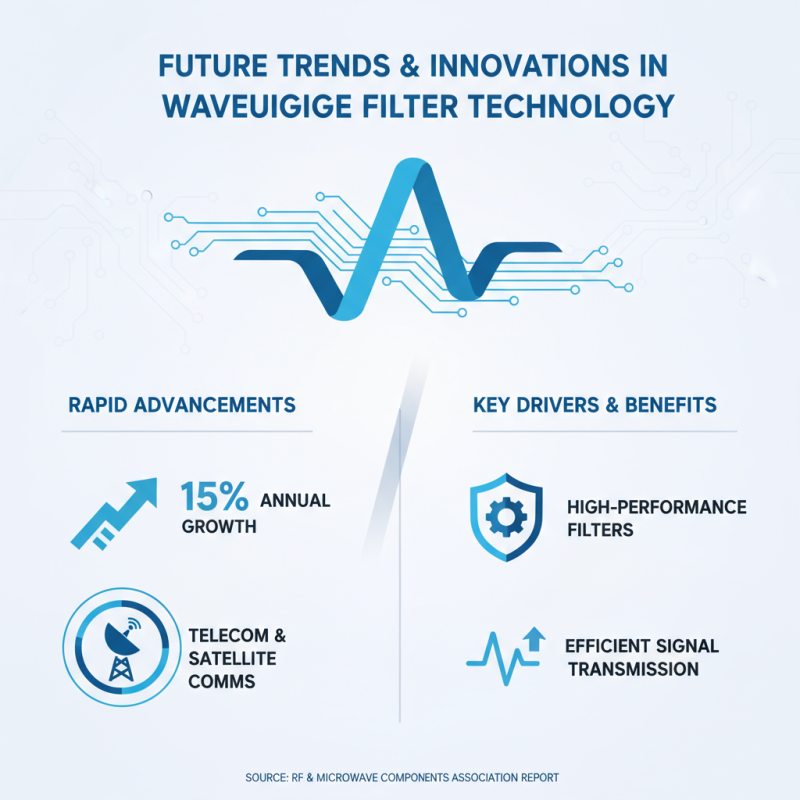
The waveguide filter industry is experiencing rapid advancements. According to a report from the RF and Microwave Components Association, the demand for high-performance waveguide filters is projected to grow by 15% annually. This growth stems from the increasing need for efficient signal transmission across various sectors, including telecommunications and satellite communications.
Innovative designs are emerging, introducing new materials that enhance performance. For example, the use of 3D printing technology allows for customized geometries that optimize signal flow. These filters can reduce insertion loss and improve bandwidth without significant cost increases. However, integrating these new materials poses challenges. Testing consistency and long-term reliability must be evaluated carefully.
Moreover, the trend towards miniaturization presents another layer of complexity. Smaller waveguide filters must maintain high performance in compact formats. Industry experts emphasize the importance of ongoing research and development to address these challenges. Future innovations may include smart filters with adaptive capabilities. Such advancements will ensure that waveguide filters meet the evolving needs of modern communication systems.